
Bitcoin Mining Methods: Home, Hosted, Cloud, and Hashrate NFTs
Every realistic way to mine Bitcoin in 2026 — home ASICs, hosted mining, cloud mining, and tokenized hashrate NFTs — with honest profitability math.
Table of contents
- State of Bitcoin mining in 2026
- How Bitcoin mining works (30-second version)
- The four ways to mine Bitcoin in 2026
- Home ASIC mining — deep dive
- Hosted mining — deep dive
- Hashrate NFTs (GoMining) — deep dive
- Method 1: Home ASIC mining
- Method 2: Hosted mining
- Method 3: Cloud mining (legacy contracts)
- Method 4: Hashrate NFTs
- Best Bitcoin mining method by use case
- Which method should you choose?
- The "just buy BTC" reality check
- Looking ahead
- How to actually evaluate a mining deal
State of Bitcoin mining in 2026
Bitcoin network hashrate is ~940 EH/s as of late May 2026, well below the all-time peak of 1.442 ZH/s set in September 2025. Difficulty sits at ~138.96 T. Hashprice has compressed to ~$35–38/PH/day. The only retail edge that matters is electricity below $0.055/kWh. Last verified: 2026-05-31.
Since the April 2024 halving cut the block subsidy from 6.25 to 3.125 BTC, hashprice (revenue per PH/day) has been under sustained pressure. The September 2025 all-time hashrate peak of 1.442 ZH/s was followed by a decline to ~940 EH/s by late May 2026 — driven by low BTC prices (BTC fell to ~$73–77k by late May versus a prior cycle high near $109k in January 2025), difficulty retaining much of its peak level, and marginal miners going offline.
Bitcoin network hashrate peaked at 1.442 ZH/s on September 20, 2025 and has since pulled back to ~940 EH/s as of May 31, 2026 (CoinWarz). January 2026 saw the 7-day moving average briefly touch 1.05–1.13 ZH/s before US winter storms forced Texas curtailments. Mining difficulty currently stands at ~138.96 T after the April 16 retarget lifted it from ~133.79 T, with the next adjustment around June 12 projected to ease ~1% to ~137.35 T. Bitcoin's total energy use is ~138 TWh/year per Cambridge CCAF (their 2025 baseline from 48% of global mining activity), or roughly 0.5% of global electricity — other methodology-dependent estimates range up to ~180 TWh/year.
The miners who survived 2022–2024 share three traits: power costs under $0.05/kWh, fleet efficiency under 20 J/TH, and balance sheets that didn't lever BTC at the top. The publicly traded operators that violated any of those (Core Scientific, Compute North, Iris Energy at points) either restructured or got close. If you're modeling a personal mining operation, model it the way they should have: with BTC down 30% and difficulty up 20% from current.
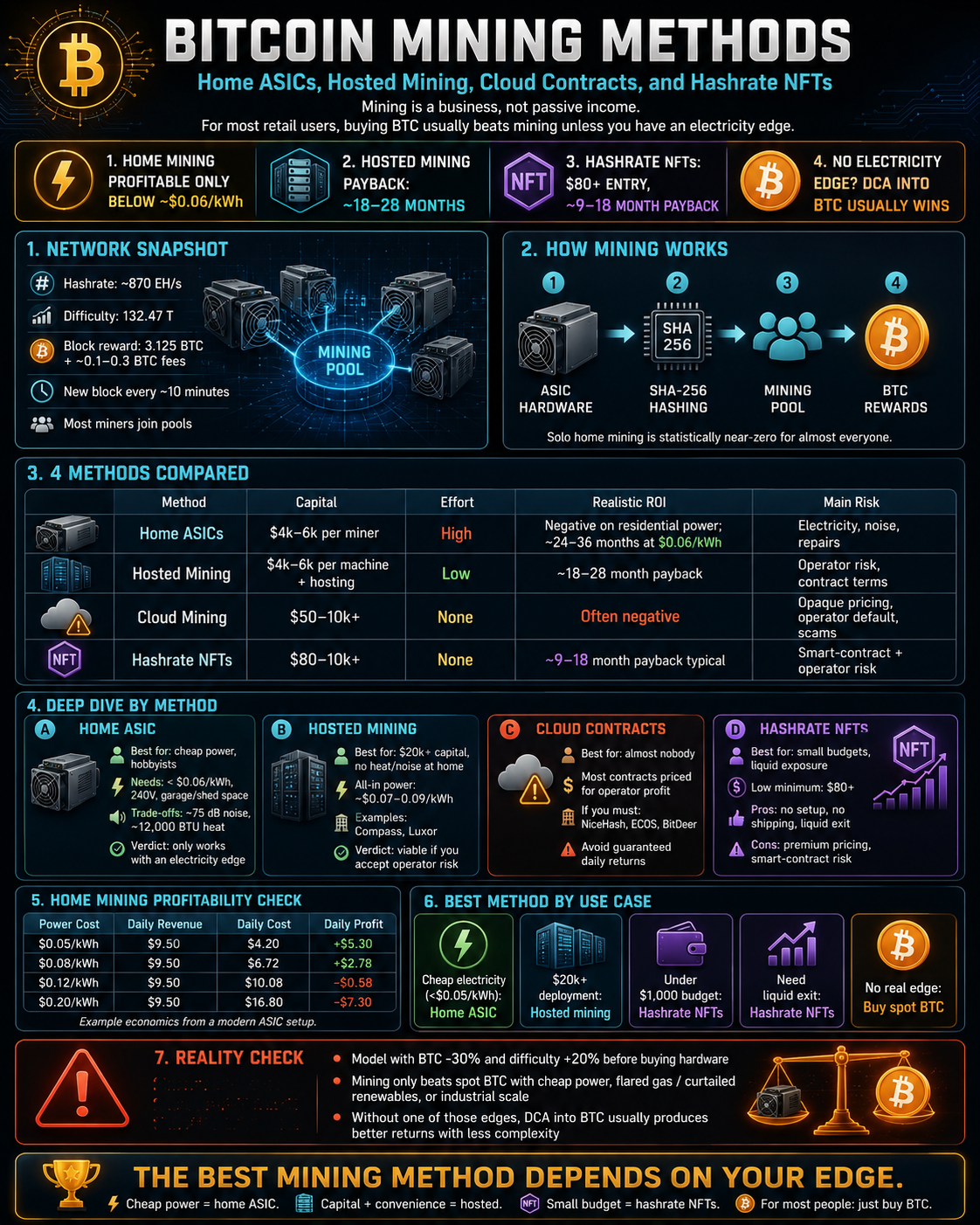
Bitcoin mining methods compared — home ASICs, hosted mining, cloud contracts, and hashrate NFTs, including costs, payback, risk, and when buying spot BTC wins.
How Bitcoin mining works (30-second version)
ASIC miners race to find a SHA-256 hash matching network difficulty. The winner of each ~10-minute round earns 3.125 BTC plus fees (~15% of total miner revenue in 2026). Solo home mining is statistically near-zero — everyone joins pools. Last verified: 2026-05-31.
Miners run specialized hardware (ASICs) that compute trillions of SHA-256 hashes per second, racing to find one that matches the network's current difficulty target. The winner of each ~10-minute round mines the next block and collects:
- 3.125 BTC block subsidy (post-April 2024 halving)
- ~0.1–0.3 BTC in transaction fees (averaging ~15% of total miner revenue in 2026; spikes higher during Ordinals/Runes/BRC-20 activity)
Solo mining a block at home is statistically near-zero unless you control >0.01% of network hashrate (~9.4 PH/s at current 940 EH/s). Everyone else joins mining pools that share rewards proportionally.
The four ways to mine Bitcoin in 2026
Home ASICs (need sub-$0.055/kWh power at current $77k BTC), hosted mining (Compass ~$0.06–0.065/kWh all-in), legacy cloud contracts (mostly bad deals), hashrate NFTs via GoMining (GoMining tokenizes real ASIC capacity into transferable NFTs that pay BTC rewards proportional to their hashrate rating) (lowest entry, best liquidity). Last verified: 2026-05-31.
| Method | Capital | Effort | Realistic ROI | Risk |
|---|---|---|---|---|
| Home ASICs | $3.8k–13.5k per miner | High (cooling, noise, repairs) | Negative on residential power at $77k BTC | High electricity exposure |
| Hosted mining | $3.8k–13.5k + monthly hosting | Low | 24–36+ month payback at $0.06/kWh | Operator risk, contract terms |
| Cloud mining (legacy) | $50–10k+ | None | Often negative or scam | Operator default, opaque |
| Hashrate NFT (GoMining etc.) | $80–10k+ | None | Variable; depends on BTC price and maintenance costs | Smart-contract + market risk |
Home ASIC mining — deep dive
Home mining is profitable only if your power bill makes it profitable. Pool choice, firmware tuning, and immersion cooling matter far less than the kWh price.
Best for
Operators with sub-$0.055/kWh electricity (industrial, off-grid solar, heat-recovery setups). Hobbyists who want hands-on experience.
Trade-offs
Single S21 Pro = 3.51 kW continuous, 75 dB noise (lawn-mower equivalent), 12,000 BTU heat output. At ~$77k BTC and ~$37/PH/day hashprice, gross daily revenue is ~$8.33 — a machine on US residential power ($0.12/kWh) spends $10.11/day just on electricity. You also absorb breaker upgrades (most residential 120V circuits won't run an S21), insurance complications, and the failure mode where a hash board dies and you're shipping a 35-pound machine back to Shenzhen for RMA.
Capital & payback
$3,800 (S21 XP, air-cooled) to $13,500 (S23 Hydro, liquid-cooled) per machine. Negative payback on residential power; at $0.05/kWh and $37 hashprice the S21 Pro nets ~$4/day, implying 3–4 year payback at current BTC. Add ~$500 for a beefier PDU, breaker work, and ducting if you actually want it to run reliably.
Hosted mining — deep dive
Hosted mining suits operators with $20k+, no electricity edge, and no appetite for hands-on hardware management.
Best for
Operators with $20k+ capital who want professional management, no noise/heat at home, and access to industrial power rates without building a facility.
Trade-offs
12–24 month contracts, hosting operator risk (Compute North filed Chapter 11 in 2022; Core Scientific went through bankruptcy in 2022–2024; several smaller hosts simply ghosted customers). Less liquid than NFT format — you can't sell a contract on a secondary market mid-term. Read the contract for the "force majeure" clause, the curtailment policy, and what happens to your machine if the host goes bankrupt — in some 2022 cases, customers lost both uptime and hardware.
Capital & payback
$3.8k–13.5k capex per machine + ~$0.06–0.09/kWh all-in hosting (Compass charges ~$0.06–0.065/kWh as of 2026). At $37 hashprice and $77k BTC, payback stretches to 24–36+ months even at $0.06/kWh — significantly longer than 2025 projections. Run the model with curtailment hours included — Texas hosts can park your fleet for 100+ hours a year during ERCOT peaks.
 Hashrate NFTs (GoMining) — deep dive
Hashrate NFTs are the only retail mining instrument with on-chain secondary-market liquidity — tradable exit is the differentiating property, alongside low minimums and no setup.
Best for
Retail buyers wanting BTC mining exposure with low minimums ($80+) and on-chain liquidity. No shipping, no setup, no maintenance. Good for testing whether you actually want to be in mining before committing $20k to hosted.
Trade-offs
GoMining charges electricity at $0.05–0.07/kWh plus ~$0.0089/TH/day in maintenance fees. Those costs are deducted from daily BTC rewards — in a compressed-hashprice environment like May 2026, thin margins mean smaller NFTs may earn near zero net after fees. Smart-contract risk on top of operational risk. Dependent on operator continuing to run hardware. Electricity costs adjust with hashprice, compressing margins in down markets.
Capital & payback
$80 → $10k+. Payback depends entirely on BTC price trajectory and GoMining's fee structure relative to hashprice. The liquid secondary-market exit is the key differentiator — useful if mining economics deteriorate and you want out before a contract would otherwise end.
→ Start with GoMining (referral link — tokenized hashrate NFTs; lowest entry ($80+) and best secondary-market liquidity for small miners)
Method 1: Home ASIC mining
Profitable only with sub-$0.055/kWh electricity at current ~$77k BTC. Requires 75 dB tolerance plus 12,000 BTU heat per machine. Residential US power loses money on any modern ASIC. Last verified: 2026-05-31.
Buy an Antminer S21 XP (270 TH/s, 13.5 J/TH, ~$3,800) or S21 Pro (234 TH/s, 15 J/TH), plug into a 240V outlet, point at a mining pool (Foundry USA (Foundry USA is the largest North American Bitcoin mining pool, operated by Foundry Digital and routinely mining 25–30% of new blocks), F2Pool, Antpool), and start hashing.
Realistic at home only if:
- You have access to <$0.055/kWh electricity (industrial / off-grid solar / heating recovery)
- You can dedicate a garage, shed, or basement (75 dB = lawn mower noise)
- You're comfortable handling 12,000 BTU heat output per machine
Profitability check (May 27, 2026: BTC = $77k, hashprice ≈ $37/PH/day, S21 Pro 234 TH/s, 84 kWh/day):
| Power cost | Daily gross revenue | Daily electricity cost | Daily net |
|---|---|---|---|
| $0.04/kWh | $8.66 | $3.37 | +$5.29 |
| $0.055/kWh | $8.66 | $4.63 | +$4.03 |
| $0.08/kWh | $8.66 | $6.74 | +$1.92 |
| $0.12/kWh (US residential) | $8.66 | $10.11 | -$1.45 |
| $0.20/kWh (CA, NY, EU) | $8.66 | $16.85 | -$8.19 |
Daily gross = 234 TH/s × $0.037/TH/day. Excludes pool fees (~1%) and hardware amortization.
Verdict: Home mining is profitable only with sub-residential electricity rates. At $77k BTC, breakeven sits at roughly $0.055/kWh on an S21 Pro.
Method 2: Hosted mining
Buy ASICs, ship to Compass (Compass Mining is a US-based ASIC retailer and hosting marketplace that connects retail buyers with industrial-scale mining sites) or Luxor (Luxor Tech is a Bitcoin mining infrastructure company offering hosting, an integrated pool, and the Hashrate Index data product) at ~$0.06–0.065/kWh all-in (Compass 2026 rates). Payback stretches to 24–36+ months at current ~$77k BTC and ~139 T difficulty. Last verified: 2026-05-31.
You buy ASICs and ship them to a data center (Compass, Luxor, Bitmain Hosting, Marathon), which provides power, cooling, and maintenance for ~$0.06–0.09/kWh all-in.
Pros: Access to industrial power rates, professional management, no noise/heat at home. Cons: $3.8k–13.5k capex per machine, 12–24 month contracts, hosting operator risk (some have collapsed). At current hashprice and BTC price, payback is long — 24–36+ months even at Compass's ~$0.06/kWh rate.
Best providers (May 2026):
- Compass Mining (US, transparent pricing, ~$0.06–0.065/kWh all-in)
- Luxor Tech (US, integrated pool, Hashrate Index data)
- Bitmain Hosting (varies by location)
Payback: 24–36+ months at current ~$77k BTC and ~$37/PH/day hashprice. If BTC recovers above $100k, payback compresses materially — but model the downside first.
Method 3: Cloud mining (legacy contracts)
Most cloud-mining contracts are priced so the operator captures the margin. Use NiceHash, ECOS, or BitDeer if you must — avoid anything with "guaranteed daily returns" or referral pyramids. Last verified: 2026-05-31.
You buy a hashrate "contract" from an operator. Most are bad deals.
Reputable in 2026:
- NiceHash (marketplace, you rent or sell hashrate)
- ECOS (regulated, Armenia-based)
- BitDeer (Bitmain spinoff, public company)
Avoid:
- Anything advertising "guaranteed 1% daily returns"
- Anonymous operators
- HYIP-style platforms with referral pyramids
Verdict: Cloud mining contracts are usually priced so the operator captures most of the margin. Use only if you can't access hosted mining and understand the counterparty risk.
Method 4: Hashrate NFTs
Tokenized ASIC capacity from GoMining and similar operators. $80 minimum, on-chain liquidity, no shipping or noise. Electricity costs $0.05–0.07/kWh plus ~$0.0089/TH/day maintenance, deducted from daily BTC rewards. Last verified: 2026-05-31.
Tokenized hashrate (GoMining, others) wraps real ASIC capacity in tradable NFTs. You earn BTC daily, pay electricity and maintenance fees in tokens or USDT, and can sell your position on secondary markets.
Pros: Liquid exit, lower minimums ($80+), on-chain transparency, no shipping/setup. Cons: At ~$37/PH/day hashprice and GoMining's ~$0.0089/TH/day maintenance fee, margins are compressed in May 2026. Smart-contract risk, dependent on operator continuing to run hardware.
See our GoMining Review for a deep dive.
Best Bitcoin mining method by use case
Match method to your edge: home ASIC for sub-$0.05/kWh power, hosted for $20k+ no-edge capital, hashrate NFTs for under $1k, industrial for >1,000 ASIC scale, spot BTC for everyone else. Last verified: 2026-05-31.
- Best mining method for sub-$0.05/kWh electricity — Home ASIC (Antminer S21 XP or S21 Pro for air-cooled; S23 Hydro for liquid-cooled at scale).
- Best mining method for $0.06–0.08/kWh — Hosted mining (Compass, Luxor) — barely viable at current BTC; model the downside.
- Best mining method for under $1,000 budget — Hashrate NFTs (GoMining).
- Best mining method for liquid exit — Hashrate NFTs (sell on secondary NFT marketplace).
- Best mining method for institutional / >1,000 ASIC scale — Self-operated industrial site (Riot, Marathon, CleanSpark model).
- Best mining method for flared-gas / curtailed-renewable arbitrage — Containerized ASIC deployment (Crusoe-style).
- Best mining method to heat your home — A single ASIC piped into a basement or workshop ducted system (heat-recovery economics partially offset electricity cost).
- Best mining method for hobbyist learning — Cheap used ASIC (Antminer S19 XP) + solo pool for educational value, not profit.
- Best alternative to mining — Buy spot BTC. If you don't have an electricity edge below $0.05/kWh, DCA beats mining every cycle since 2020.
Which method should you choose?
Cheap power + industrial space: home ASIC. $20k+ and no edge: hosted via Compass or Luxor. $100–5,000 to experiment: GoMining hashrate NFTs. Anything else: just buy spot BTC. Last verified: 2026-05-31.
- Have sub-$0.05/kWh power and appropriate space: Home ASIC (S21 XP at $3,800 is the best air-cooled entry).
- Have $20k+ to deploy and tolerance for 24–36 month payback: Hosted mining via Compass or Luxor.
- Have $100–5,000 to experiment with mining exposure: Hashrate NFTs (GoMining).
- Have any other situation: Just buy spot BTC. Mining only beats spot BTC if you have a genuine electricity advantage.
The "just buy BTC" reality check
Over the last two halvings (2020–2024), spot BTC outperformed nearly every retail mining setup. At $77k BTC and ~$37/PH/day hashprice in May 2026, mining only generates alpha with sub-$0.04/kWh power, flared-gas/curtailed-renewable access, or >1,000 ASIC industrial scale. Last verified: 2026-05-31.
Mining only generated alpha over spot BTC for operators with:
- Sub-$0.04/kWh electricity, OR
- Access to flared natural gas / curtailed renewables, OR
- Industrial scale (>1,000 ASICs)
Without one of those edges, DCA into BTC typically produces better returns with less complexity. Mining is a business, not passive income.
Looking ahead
A few signals to watch through the next halving cycle:
- Next halving (~April 2028, block 1,050,000) — block subsidy drops from 3.125 to 1.5625 BTC. Hashprice will roughly halve overnight unless transaction fees or BTC price appreciation compensate. Any mining contract that doesn't survive a 50% revenue cut in 2028 is a 2-year investment, not a 5-year one.
- Transaction-fee share of miner revenue — currently fees average ~15% of revenue in 2026 (spikes during Ordinals/Runes/BRC-20 surges). If Bitcoin L2s and application activity drive that sustainably above 20%, miner economics partially decouple from the subsidy halvings. If fees stay at 15%, post-2028 miner attrition accelerates.
- AI/HPC pivot from public miners — Core Scientific raised $3.3B in bonds in April 2026 to fund six AI data centers leased to CoreWeave (~$10.2B projected revenue over 12 years); shareholders blocked a $9B CoreWeave full acquisition. Hut 8 secured a $7B Google-backed AI infrastructure deal and a separate $9.8B 15-year lease at Beacon Point. Riot is exploring HPC sites. Public miner equity is increasingly a partial AI infrastructure bet, not pure BTC beta.
- ERCOT and grid-curtailment policy — Texas miners earn meaningful revenue from demand-response programs (selling power back to the grid during peaks). Any tightening of those programs compresses Texas mining margins. Winter 2026 storms already demonstrated how curtailments can pull ~12% of global hashrate offline quickly.
- ASIC efficiency floor — S21 Pro at 15 J/TH, S21 XP at 13.5 J/TH, S23 Hydro at 9.5 J/TH. The process-node floor for air-cooled SHA-256 ASICs is approaching ~10–12 J/TH; liquid-cooled machines are pushing below 10 J/TH. As efficiency gains slow, older machines stay economic longer and fleet-replacement cycles lengthen.
How to actually evaluate a mining deal
If someone pitches you a contract, run this checklist before wiring money:
- Get the all-in $/kWh in writing, including pass-through energy adjustments, hosting fees, pool fees, and maintenance. The headline rate is rarely the real rate. Compass quotes ~$0.06–0.065/kWh all-in; anything advertising below that deserves extra scrutiny.
- Confirm the ASIC make, model, and serial-number policy. "S21 Pro equivalent" is a flag — you want a specific model with a specific J/TH rating, and ideally serial-number assignment so you can verify uptime.
- Stress-test at -30% BTC, +20% difficulty, +25% energy. At $77k BTC, a -30% scenario takes you to ~$54k — most setups above $0.04/kWh go deeply negative under that scenario.
- Check the operator's track record. Has the host been in business through a halving? Did they make customers whole if they had a bankruptcy or outage? Compass and Luxor have track records; many newer hosts don't.
- Read the curtailment and force-majeure terms. How many hours per year can the host take your machine offline without compensation? Texas hosts can easily exceed 100.
- Calculate breakeven BTC price. At $37/PH/day hashprice, an S21 Pro at $0.06/kWh breaks even at roughly $60k BTC. If your deal needs BTC > $80–90k to clear, write that number on the wall. When BTC trades below it, you're losing money.
Related: GoMining Review 2026 · Best Crypto Wallets 2026
Frequently asked questions
Is Bitcoin mining still profitable in 2026?
Marginally, and only with cheap power. After the April 2024 halving, miners earn 3.125 BTC per block. At late-May 2026 hashprice (~$35–38/PH/day) and BTC near $77k, profitability requires electricity below ~$0.055/kWh on a modern ASIC (S21 Pro or better). Home miners on residential power ($0.12+/kWh) lose money at current BTC prices.
What is the most profitable Bitcoin miner in 2026?
The Antminer S23 Hydro (580 TH/s, 9.5 J/TH, ~$13,500) leads on efficiency but requires liquid cooling. For air-cooled setups, the Antminer S21 XP (270 TH/s, 13.5 J/TH, ~$3,800) is the most efficient plug-and-play option. The Antminer S21 Pro (234 TH/s, 15 J/TH) remains the accessible mid-range choice. All require sub-$0.06/kWh electricity to net positive at current BTC price (~$77k) and hashprice.
Can I mine Bitcoin at home?
Technically yes, profitably almost never. A single S21 Pro consumes 3.51 kW continuously — 84 kWh/day — costing $300–500/month on residential power. At ~$77k BTC and current hashprice, gross daily revenue is ~$8.33, well below residential electricity costs. Heat (12,000 BTU) and noise (75 dB) make home mining a hobby, not a business.
What is cloud mining?
Cloud mining is renting hashrate from a data-center operator. You pay upfront (or via subscription) for a hashrate allocation and receive BTC rewards minus electricity. Major risks: most cloud mining is overpriced or outright scams. Reputable options in 2026: NiceHash, ECOS, BitDeer, GoMining (NFT format).
What is a hashrate NFT?
A hashrate NFT (popularized by GoMining) represents tokenized real mining capacity. Each NFT corresponds to a specific TH/s rating in a real data center. You earn BTC rewards proportional to your hashrate, pay electricity costs in USDT or GOMINING tokens (~$0.05–0.07/kWh plus ~$0.0089/TH/day maintenance), and can sell the NFT on secondary markets for liquidity.
How much electricity does Bitcoin mining use?
Modern ASICs consume 9.5–18.5 watts per terahash depending on model. An S21 Pro (15 J/TH, 234 TH/s) draws 3,510W, or 84 kWh/day per machine. Cambridge CCAF puts the entire Bitcoin network at ~138 TWh/year (2025 baseline) — roughly 0.5% of global electricity production. Other methodology-dependent estimates range up to ~180 TWh/year.
What's the break-even electricity rate for home Bitcoin mining in 2026?
At late-May 2026 hashprice (~$35–38/PH/day) and BTC ~$77k, the breakeven for an Antminer S21 Pro (15 J/TH) is approximately $0.05–0.055/kWh. Above $0.06/kWh, the machine runs at a loss. Below $0.05/kWh, even older S19 XP hardware stays marginally profitable. Hashprice is the most volatile input — it dropped ~30% in early 2026 relative to 2025 peaks.
Is GoMining or NiceHash safer than running my own miner?
Different risk profiles. GoMining and NiceHash carry counterparty risk (the operator could shut down, freeze withdrawals, or quietly stop hashing on your behalf — Bitclub Network and HashFlare each defrauded users in past cycles). Running your own miner carries equipment risk, electricity rate exposure, and downtime. For under $10k, hosted mining at a reputable provider (Compass, Luxor) is the median-risk option.
How long until a new ASIC pays itself off?
At current economics ($77k BTC, ~$37/PH/day hashprice), an S21 Pro nets ~$4/day at $0.05/kWh, implying a ~$5,000 machine payback of roughly 3–4 years. At $0.08/kWh, the daily net drops to ~$1.60 and payback stretches beyond 8 years. Hashprice volatility is the dominant variable — it compressed 30%+ from 2025 highs. Never model payback at today's BTC price without stress-testing a -30% scenario.
Does Bitcoin mining still earn block rewards in 2026?
Yes. Block rewards are 3.125 BTC per block (post-April 2024 halving). The next halving (~April 2028, block 1,050,000) drops it to 1.5625 BTC. Transaction fees currently represent ~15% of total miner revenue on average in 2026, with spikes during high-activity periods (Ordinals, Runes, BRC-20 surges). The block subsidy remains the dominant revenue source at ~85% of total miner income.
Sources & further reading
- Cambridge Bitcoin Electricity Consumption Index (CBECI)
- CoinWarz — Bitcoin hashrate ~940 EH/s, May 31 2026
- KuCoin — Bitcoin hashrate 2026 trends and difficulty analysis
- Lumerin Protocol — Current State of Bitcoin Mining May 2026
- Hashrate Index (Luxor) — Bitcoin hashprice index
- D-Central — Best Bitcoin miners 2026 ASIC comparison
- Newhedge — Bitcoin hashprice chart
- GoMining FAQ — maintenance fees and electricity costs
- Compass Mining — how hosting pricing works
- Apextomining — Bitcoin hashrate hits 1 ZH/s January 2026
- Core Scientific — $3.3B bond for AI data center pivot
- ASIC profitability calculator — NiceHash S21 Pro